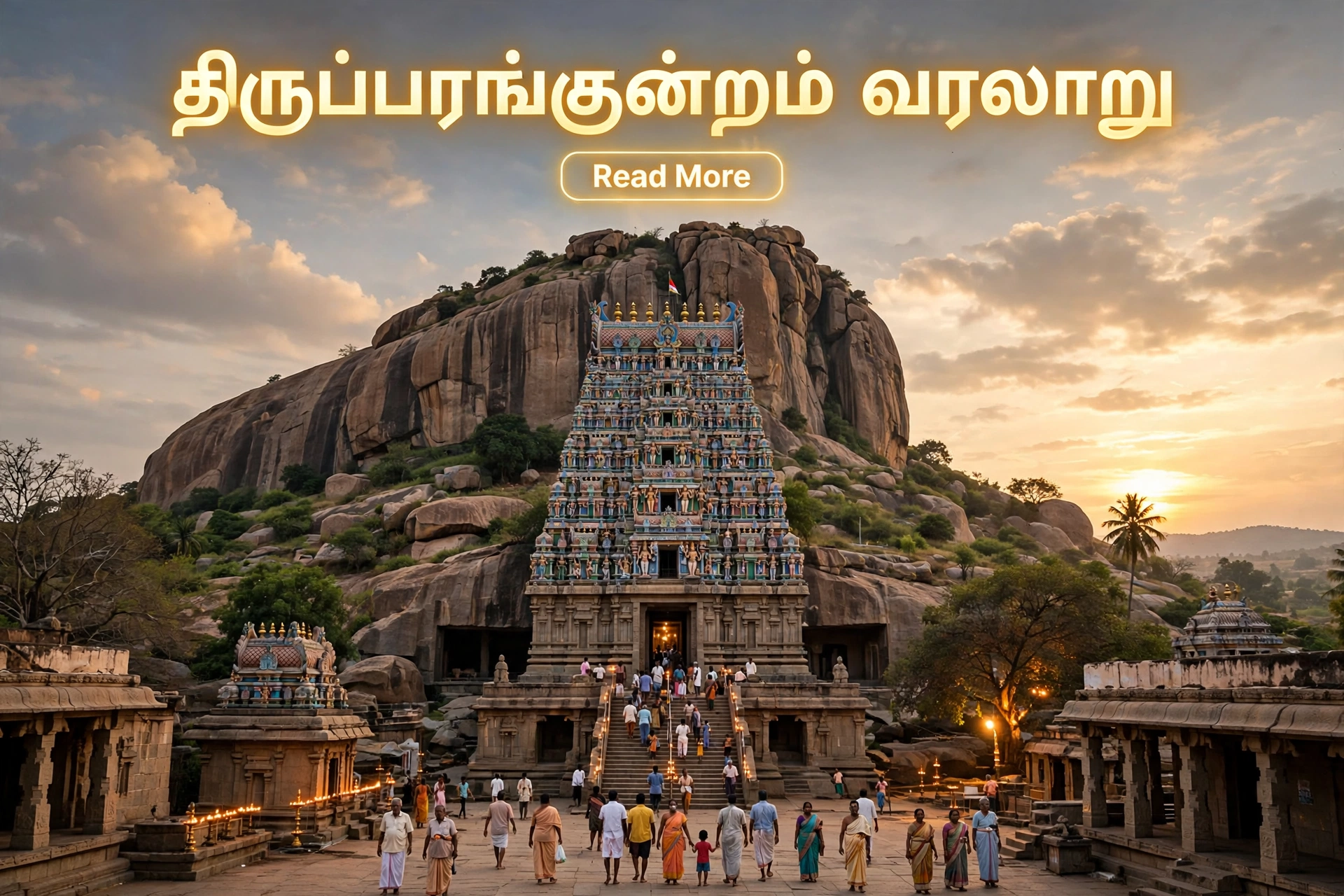
Thiruparankundram Malai is the granite hill near Madurai. The first of Murugan’s six Arupadai Veedu temples stands here. This post tells the full Thiruparankundram Malai History.
The Pandyas cut the temple into the rock itself. Its history runs from Jain stone beds of the second century BCE through Pandya rock-cut shrines and Nayak mandapams to the present day.
Tradition says Murugan married Deivayanai here. It is also the largest of the six Arupadai Veedu temples in size.
This is the full Thiruparankundram Malai History, from its Jain caves to its Nayak towers.
Where Is Thiruparankundram Malai?
Thiruparankundram Malai stands about 8 kilometres southwest of Madurai, in Tamil Nadu.
The hill is a single mass of granite that rises about 1,050 feet above sea level.
The Arulmigu Subramaniya Swamy Temple stands at its northern foot. The whole hill covers 172.2 acres, and it stands as a protected monument.
City buses run from Madurai to the temple, and the nearest railway station is Madurai Junction, 8 kilometres away.
The Name: Why Thiruparankundram?
The name breaks into three Tamil words.
Tiru means holy, Param means the supreme, which is Shiva, and Kundram means hill.
So Thiruparankundram means the holy hill of the supreme one.
Old Tamil literature calls the place by many other names. They include Thenparankundram, Thanparankundram, Parangiri, Sathya Giri, Kanda Malai and Skanda Malai.
One old story says the first shrine stood at the rear of the hill. Later, people moved it to face north. So people called the place Tirumbiya Parankundram, the hill that turned. That name became Thiruparankundram.
The hill itself has the shape of a Shiva lingam. So devotees worship the hill as Shiva in that form.
The Legend: Murugan’s Marriage to Deivayanai
After Murugan defeated the demon Surapadman, the devas gathered at Thiruparankundram to honour him.
Indra, the king of the devas, was grateful for the victory. So he offered his daughter Deivayanai in marriage to Murugan.
The wedding took place here, with Shiva, Parvati, Brahma and all the devas present.
That is why Murugan here sits in his wedding posture, with Deivayanai beside him. In most other Murugan temples, he stands.
Every year, devotees celebrate the wedding as Panguni Uthiram, in the Tamil month of Panguni. Panguni falls in March and April.
Devotees believe that praying here removes obstacles to marriage, and many come to the temple for that blessing.
The Penance of Murugan
Another old story tells why Murugan came to this hill in the first place.
On Mount Kailash, Shiva taught Parvati the meaning of the sacred sound Om. The child Murugan sat on his mother’s lap, and he heard the teaching.
The scriptures say a student must receive such knowledge from a guru, not overhear it. So Murugan came to Thiruparankundram to do penance for it.
Shiva and Parvati then appeared before him here, on the day of Thai Poosam in the Tamil month of Thai.
Devotees worship them here as Parangirinathar and Avudai Nayaki. Their temple at the foot of the hill is the Meenakshi Sundareswarar Temple.
Devotees visit that Shiva temple first, and only then go to the Murugan temple.
Devotees celebrate the Thai Poosam festival here for ten days every year.
Nakkeerar and the Cave of Tirumurugatrupadai
The poet Nakkeerar, who lived in the Sangam age, has close ties to this hill.
Tradition says a demon named Karmugi cursed Nakkeerar. He took shelter in a cave on the hill. There he sang Tirumurugatrupadai, the song that guides devotees to Murugan.
When he needed water to bathe, Murugan struck the rock with his Vel, and water sprang up.


